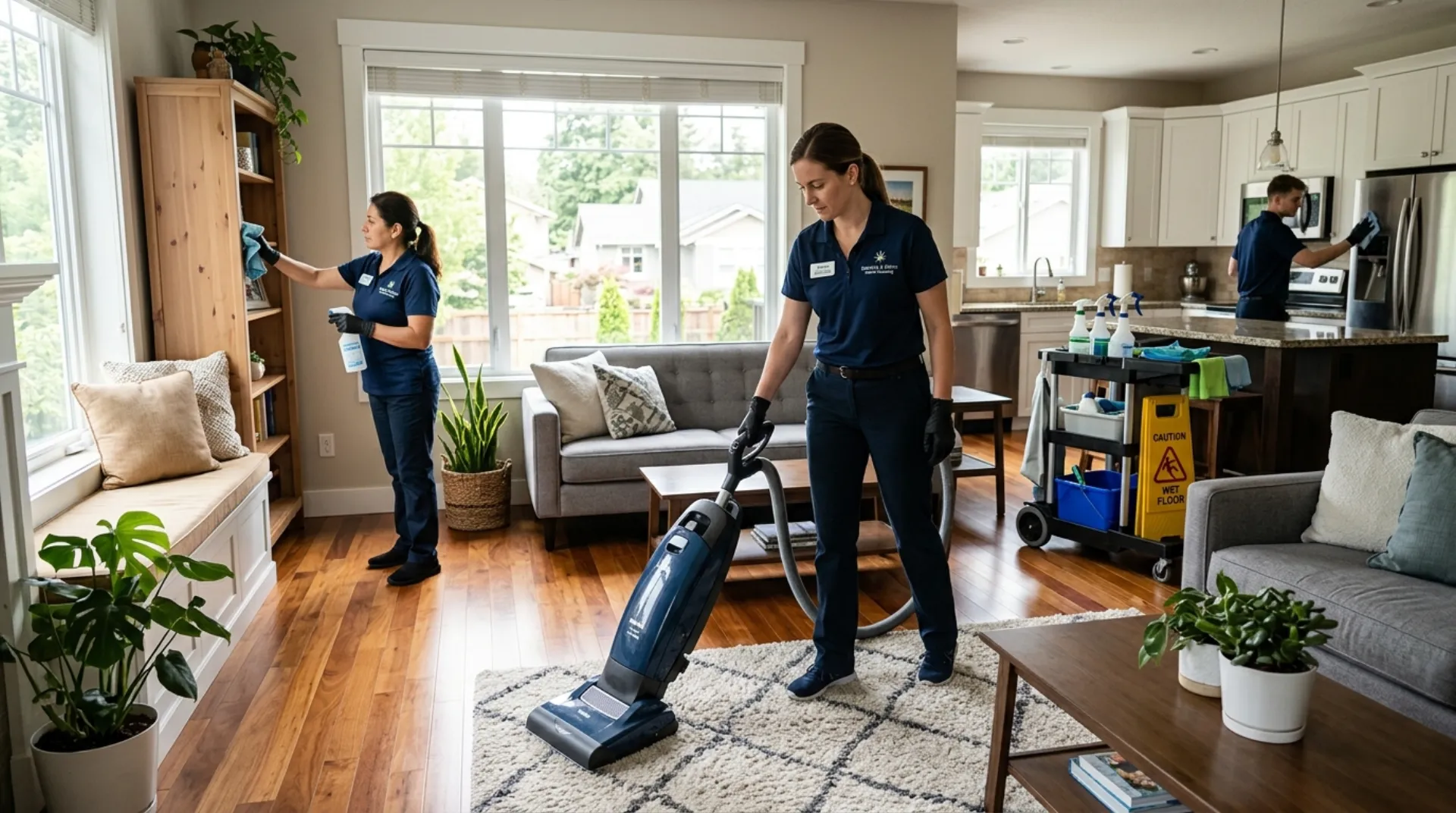
Free House Cleaning Software,
Forever.
· Pricing verified June 14, 2026
Lock your weekly and biweekly clients onto card-on-file autopay, send a tiered estimate by bedroom or square foot from your phone, see when the customer actually opens the quote, and let Menutize text a one-tap Google review the second the front door clicks shut. $0/month. Unlimited users. Forever.
Free CRM, invoicing & payments — forever. Save $228–$3,588/yr vs ZenMaid, BookingKoala, Jobber, Launch27 & Housecall Pro subscription fees.
Free house cleaning software, explained plainly
Menutize is free house cleaning software for maid services, residential cleaners, and move-in/move-out crews. It runs the office side of a cleaning business — customer CRM, branded tiered estimates, recurring weekly/biweekly/monthly billing on card on file, online card and ACH payments, automated Google review requests, tip collection, estimate and invoice open-tracking, and two-way Google Calendar sync — for $0 per month with unlimited users. There is no monthly fee, no per-seat fee, and no credit card required to start.
House cleaning is a recurring, relationship-driven trade, which is exactly why a free, payment-based tool fits it so well. The money in a maid service isn't the one-off deep clean; it's the weekly and biweekly homes that bill on autopay for years. A single weekly $150 home is roughly $7,800 a year in lifetime value, and a route of 30-60 recurring homes is a predictable book of business — if you can stop hand-invoicing each one every Monday. The tools that actually move the needle in cleaning are recurring card-on-file billing, tiered estimates that upsell the deep clean without an awkward call, and a steady flow of fresh Google reviews that keep you in the local Map Pack. Menutize was built around exactly those moments.
The platforms most cleaning companies evaluate — the maid-specific ZenMaid, BookingKoala, and Launch27, plus the general field-service tools Jobber and Housecall Pro — all charge a monthly subscription, several charge per additional user, and none offer a genuine free-forever plan (only 14-day trials). For a solo cleaner or a small maid service, those subscriptions add up to roughly $230–$3,600 per year before you've cleaned a single home. Menutize earns instead through a transparent 0.5% fee on payments you actually process, so the software costs you nothing in a slow week.
A growing share of homeowners now find cleaners through an AI answer before they ever click a website — asking ChatGPT, Perplexity, or Google's AI Overviews "how much does a biweekly house cleaning cost" or "best house cleaning service near me." Those answers are assembled from structured, factual, citation-ready content and from your local presence: your Google Business Profile, your review count and recency, and your visibility in the Map Pack. So the two highest-return investments for a maid service are now (1) a steady, automated flow of recent Google reviews and (2) recurring billing that keeps your best clients on the books without friction. Menutize is built to drive both, which is why it's a better fit for where local search is heading than a heavier platform that bills you monthly for scheduling features you'll never fully use.
The rest of this page covers what is free, the four cleaning-specific workflows Menutize is built around, a full side-by-side comparison against Jobber, Housecall Pro, ZenMaid, BookingKoala, and Launch27 with verified 2026 pricing, a plain-language read on each competitor, real house-cleaning price ranges, a five-question buying guide, a day-in-the-workflow walkthrough, an honest section on when a different tool is the right call, and the questions maid service owners actually ask before signing up.
What's Free, Forever
Everything you need to run a residential house cleaning or maid service business — not a feature gated behind an upgrade. No credit card to start. No "trial expired" email in 14 days.
Customer CRM
Every home, recurring schedule, lockbox code, photo, and note in one place. Searchable. Unlimited users, no per-seat fees.
Tiered Estimates
Send branded standard / deep / move-out estimates from your phone, priced by bedroom or square footage. Customer approves with one tap.
Recurring Card-on-File Billing
Weekly, biweekly, or monthly autopay on the card on file. The route bills itself — no more hand-invoicing 40 homes on Mondays.
Card & ACH Payments
Customers pay online or via card on file. Money lands in 1-2 business days. ACH at 0.8% (capped at $5) is the cheap rail for big move-out invoices.
Google Review Requests
Auto-text every happy customer a one-tap review link the moment you mark the clean done.
Tip Collection
Built-in 15/20/25% tip prompts at checkout. Cleaning averages 15-25% — tips route straight to the operator.
Built for the way house cleaning actually works.
House cleaning isn't general handyman work. Recurring weekly and biweekly clients are the lifeblood, deep cleans subsidize the slow weeks, move-out turns for property managers are the steady commercial B2B, and one no-show on a Friday torches the cleaner's whole day. The free plan accounts for all of it.
Most "free" small-business tools are a generic invoice template with a Stripe button bolted on — fine for a freelance designer, useless the second you've got 35 weekly homes on autopay, a property manager wanting four move-out turns this month, a "you missed the guest bedroom we just added" call on the way to lunch, and a deep-clean inquiry from someone who hasn't had professional cleaning in three years. Menutize was built around the four workflows below: the ones that actually decide whether a maid service has a steady, compounding year or just runs the truck a lot.
Recurring Weekly / Biweekly / Monthly Billing on Card on File
Recurring is where house cleaning makes its money. A weekly $150 home is roughly $7,800/yr in lifetime value; a one-shot $350 deep clean is one paycheck. Set the cadence on each customer record (every week, every other week, every four weeks), require a card on file at first booking, and Menutize charges automatically the day of each clean and rebooks the next slot. You stop hand-invoicing 40 customers every Monday morning, you stop being the awkward one asking for the check at the door, and the no-show problem largely disappears because the customer knows there's real money committed before the route runs. On the legacy platforms recurring billing is a paid-tier feature; on Menutize it's the free-plan flagship.
Tiered Estimates: Standard, Deep, Move-Out
A 3-bed/2-bath standard biweekly clean prices differently than the deep clean for that same home, which prices differently than the move-out turn for the rental down the street. Build line items by bedroom and bathroom (1/1, 2/2, 3/2, 4+) or by square-footage band (under 1,500, 1,500-2,500, 2,500-3,500, 3,500+) for the standard rate, then publish deep clean as its own tier at 1.7-2.2x standard, and move-in/move-out as a flat-rate or hourly tier with supplies-included or supplies-extra toggles. Add-ons for oven ($35), inside fridge ($35), inside windows, baseboards, and garage are line items the customer opts into at approval. The customer sees the math line by line, taps to approve, and pays the deposit — and the visual tier comparison does the up-sell work for you.
Estimate & Invoice Open-Tracking
A $480 move-out quote sitting unread is a different problem than one the property manager has opened twice but hasn't approved. Menutize logs the moment the customer opens the estimate email, the moment they view the live estimate page, and does the same on every invoice through to the moment they pay. You stop guessing whether the spouse has actually seen the deep-clean quote, you stop chasing leads who already moved on, and your follow-up calls land on the right people at the right time. Most field-service tools gate this behind a paid tier; Menutize ships it on the free plan because nothing else moves estimate close-rate as much for cleaning operators.
Tip Prompts at Checkout (Cleaning Averages 15-25%)
House cleaning is one of the highest-tipping service trades in the country, especially among the recurring relationship clients who genuinely love their cleaner. The customer just walked into a spotless home, the cleaner spent two hours on it, and they want to say thank you — if you give them the way to do it. Customers see a 15/20/25% tip prompt right at the payment screen, the same flow they're used to from Square and DoorDash. On a $150 biweekly home that's roughly $22-37 a visit; on a four-house day, $90-150 in tips you would have left on the table. Tips route straight to whichever account the operator picks — no platform skim, no "we'll process this next month." Hardly any competitor in this list supports tip collection at all.
Three Things Every House Cleaning Pro Wishes They Had
Most "free" software either nags you to upgrade or leaves out the features that actually move the needle. Menutize makes the three biggest ones core to the free plan.
Auto Google Reviews
The moment you mark a clean complete, the customer gets a one-tap review link by text. No copy-paste, no awkward ask at the door. House cleaning runs heavily on Google reviews and the local Map Pack — the next homeowner two streets over picks you on the star count and the recency of your last review. Review volume and recency are among the strongest local-ranking signals, so automating the ask after every clean compounds month over month. Most operators see their rating climb in the first 60 days.
Included free, forever.
Tip Requests at Checkout
Customers see a 15/20/25% tip prompt right at payment — the same flow they're used to from Square or DoorDash. House cleaning averages 15-25% tips, especially on recurring relationship clients. On a $150 biweekly clean that's $22-37 a visit; on a four-house day, $90-150 in tips that net straight to the cleaner instead of the customer guiltily forgetting. Almost none of the maid-specific or general field-service platforms ship tip collection.
Included free, forever.
Google Calendar Two-Way Sync
Every booking lands in your real Google Calendar. Block time on your phone — kid's appointment, supply run, lunch — and Menutize won't let customers book over you. Jobber and Housecall Pro reserve their richer scheduling and calendar features for paid tiers; Menutize includes two-way Google Calendar sync at $0/mo.
Included free, forever.
Menutize vs Jobber vs Housecall Pro vs ZenMaid vs BookingKoala vs Launch27
A feature-by-feature comparison for house cleaning and maid service businesses, with pricing verified from each vendor's pricing page or current public listings on June 14, 2026. Menutize is the only option with a genuine free-forever plan and unlimited users.
| Feature | Menutize Free | Jobber | Housecall Pro | ZenMaid | BookingKoala | Launch27 |
|---|---|---|---|---|---|---|
| Starting price | $0/mo, forever | $29/mo annual ($49 m/m), Core | $59/mo annual ($79 m/m), Basic | $19/mo, Starter | $27/mo, Starter | ~$59/mo, Base |
| Most-popular / mid tier | n/a — one free plan | Grow $149–$299/mo annual ($199–$399 m/m) | Essentials $149/mo annual ($189 m/m) | Pro $39/mo (unlimited appts) | Growing $57/mo | Pro ~$125/mo |
| Top tier | n/a | Plus $529/mo annual ($699 m/m) | MAX $299/mo annual ($329 m/m) | Pro Max $49/mo | Premium $197/mo | Plus $299/mo |
| Free-forever plan | Yes | No (14-day trial) | No (14-day trial) | No (14-day trial) | No (trial only) | No (trial only) |
| Users included / add-on | Unlimited, $0/user | 1–15 by tier; +$29/user/mo | 1–8 by tier; MAX +$35/user/mo | Scales with team size | 5–15 providers by tier | Unlimited users (flat rate) |
| Annual contract required | No | No (annual prepay = lower price) | No (annual prepay = lower price) | No (monthly) | No (monthly) | No (monthly) |
| Recurring weekly/biweekly autopay | Yes — free | Yes (paid plan) | Yes (paid plan) | Yes (paid plan) | Yes (paid plan) | Yes (auto-billing, Plus) |
| Tiered estimates (standard/deep/move-out) | Yes — free | Yes (paid plan) | Yes (paid plan) | Yes (paid plan) | Yes (booking forms, paid) | Yes (booking forms, paid) |
| Estimate & invoice open-tracking | Yes — free | Higher tier | Higher tier | Limited | Limited | Limited |
| Card payments & pricing by bedroom/sq ft | Yes (card & ACH) — free | Yes (paid plan) | Yes (paid plan) | Yes (paid plan) | Yes (paid plan) | Yes (paid plan) |
| ACH at 0.8% (capped $5) | Yes — free | Card-focused; varies | Card-focused; varies | Card-focused; varies | Card-focused; varies | Card-focused; varies |
| Automated Google review requests | Yes — free | Add-on / higher tier | Higher tier | Add-on / varies | Rating system (paid plan) | Automated feedback (Pro) |
| Tip collection at checkout | Yes — free | Rarely supported | Rarely supported | Rarely supported | Rarely supported | Rarely supported |
| Two-way Google Calendar sync | Yes — free | Higher tier | Higher tier | Yes (scheduling core) | Yes (scheduling, paid) | Yes (scheduling, paid) |
| Customer-facing online booking site | Hosted page free; own-domain widget = add-on | Yes (paid plan) | Yes (paid plan) | Yes (booking form) | Yes — core strength | Yes — core strength |
| Maid-route / recurring schedule depth | Yes — recurring billing + calendar, free | General field-service scheduling | General field-service scheduling | Yes — core strength | Yes (smart scheduling, paid) | Yes (self-booking, paid) |
| Est. 1st-year software cost (1 owner + 1 cleaner) | $0 | ~$348+ (Core annual; +$29/mo for 2nd user) | ~$708+ (Basic annual; 2nd user needs Essentials ~$1,788) | ~$228–$588 (Starter–Pro Max) | ~$324–$684 (Starter–Growing) | ~$708+ (Base flat rate, unlimited users) |
Pricing verified from each vendor's official pricing page or current public listings on June 14, 2026. Jobber: Core $29/mo annual ($49 month-to-month), Connect $99–$149/mo annual, Grow $149–$299/mo annual, Plus $529/mo annual; +$29/user/mo; 14-day trial only. Housecall Pro: Basic $59/mo annual ($79 m/m), Essentials $149/mo annual ($189 m/m), MAX $299/mo annual ($329 m/m, +$35/extra user); 14-day trial only. ZenMaid: Starter $19/mo (up to 40 appointments), Pro $39/mo (unlimited), Pro Max $49/mo; 14-day trial; price scales with team size; no free-forever plan. BookingKoala: Starter $27/mo (up to 5 providers), Growing $57/mo (up to 15 providers), Premium $197/mo; free trial only, no free version. Launch27 (rebranded Automaid): flat-rate Base ~$59/mo, Pro ~$125/mo, Plus $299/mo with unlimited users; free trial only (exact Base/Pro figures vary slightly by listing). Card-processing fees apply on all platforms; Menutize uses standard Stripe rates plus a transparent 0.5% fee on payments processed. First-year estimates assume annual-prepay pricing where available and exclude processing fees.
Menutize vs each platform, in plain language
The table above is the quick scan. Here is the honest, vendor-by-vendor read for a maid service owner deciding where to put the office work — what each tool costs, who it's actually for, and where Menutize wins or loses.
Menutize vs Jobber
Jobber is the default starter platform for home-services trades, and it's a solid product. The friction for a maid service is the pricing ladder. Core is $29/mo on an annual plan ($49 month-to-month) but includes only one user. The popular Grow tier — the one Jobber's own trial drops you into — runs $149–$299/mo annually ($199–$399 month-to-month) and includes ten users, and the top Plus tier is $529/mo annually. Every additional user beyond a plan's cap is $29/mo. There is no free-forever plan; you get a 14-day trial and then the card is charged.
For a one-to-five person cleaning business, the math rarely favors Jobber. A solo cleaner who just needs recurring billing, tiered estimates, reviews, tips, and a calendar is paying $348/yr minimum on Core, or stepping up to Grow's four-figure annual cost for features Menutize includes free. Menutize matches Jobber on the core cleaning workflow — estimates, online payments, scheduling — and adds recurring card-on-file billing, estimate open-tracking, tip collection, and Google review automation on the free plan rather than gating them. Pick Jobber if you want its broader integrations ecosystem and don't mind the subscription. Pick Menutize if you want the same job-winning workflow at $0/mo with unlimited seats.
Menutize vs Housecall Pro
Housecall Pro is polished and popular with residential service businesses. Its Basic plan is $59/mo annually ($79 month-to-month) for a single user, Essentials is $149/mo annually ($189 month-to-month) for up to five users, and MAX is $299/mo annually ($329 month-to-month) for up to eight users with additional MAX seats at $35/mo each. Like Jobber, there is no free tier — only a 14-day trial.
The catch for a small maid service is that the single-user Basic plan is too thin for a crew operation, so most cleaning companies that need multiple logins land on Essentials at roughly $1,788/yr. That's a meaningful fixed cost for a business whose week-to-week revenue can swing. Menutize gives a five-person crew unlimited logins at $0/mo and includes the recurring billing, review automation, tip collection, and open-tracking Housecall Pro reserves for higher tiers. Pick Housecall Pro if you specifically want its consumer-financing and marketing add-ons. Pick Menutize if you want to keep that $700–$1,800/yr and run the same daily workflow free.
Menutize vs ZenMaid
ZenMaid is the most maid-specific tool on this list, purpose-built for cleaning companies and well-liked for its recurring scheduler and route management. Its published tiers are Starter at $19/mo (up to 40 appointments a month), Pro at $39/mo (unlimited appointments), and Pro Max at $49/mo, each with a 14-day trial and no free-forever plan; the price scales with your team size, so a bigger crew costs more.
ZenMaid's real strength is depth in maid-service scheduling — recurring routes, last-minute reschedules, and cleaner assignments. Menutize doesn't try to out-schedule ZenMaid; what it does is the revenue workflow — recurring card-on-file billing, tiered estimates, online card and ACH payments, tip collection, and automated Google reviews — at $0/mo with unlimited users. ZenMaid's headline price is low, but it's still a monthly bill that grows with your team and excludes the tip and review automation that quietly add revenue. Pick ZenMaid if you want its specialized cleaning scheduler and don't mind paying monthly. Pick Menutize if you want recurring billing, reviews, and tips with no monthly fee and no per-cleaner pricing.
Menutize vs BookingKoala
BookingKoala is booking-and-scheduling software popular with cleaning companies that want a polished customer-facing booking site on their own domain. Its published tiers are Starter at $27/mo (up to 5 providers, your own domain, booking forms, smart scheduling), Growing at $57/mo (up to 15 providers, advanced reports, referral and rating system, gift cards, GPS clock-in, SMS), and Premium at $197/mo (full marketing automation). There's a free trial but no free-forever plan.
BookingKoala's edge is genuinely its front-end: a customizable, branded online booking experience is the product's whole pitch. If a self-service booking website is the centerpiece of your model, that's worth paying for. Menutize gives you a free hosted booking page that handles the 90% of customers who find you on Google or referral, plus recurring billing, tiered estimates, tip collection, and review automation at $0/mo — and a fully native booking widget on your own domain is an optional add-on if you ever need it. Pick BookingKoala if a custom-domain self-booking site is your core differentiator. Pick Menutize if you want the recurring-revenue and reviews engine free and a hosted booking page is enough.
Menutize vs Launch27
Launch27 (rebranded Automaid) is online-booking and CRM software for cleaning businesses, and its distinguishing feature is a flat-rate model with unlimited users on every plan: Base around $59/mo, Pro around $125/mo (analytics, automated feedback, premium booking forms, QuickBooks and Zapier, text reminders), and Plus at $299/mo (auto-billing, referral engine, gift cards, mobile app, multi-location). There's a free trial but no free-forever plan, and the exact Base and Pro figures vary slightly by listing.
Launch27's unlimited-user flat-rate pricing is the right instinct for a crew business — you don't get nickel-and-dimed per cleaner. Menutize matches that economics exactly but at $0/mo instead of $59–$299, and adds recurring card-on-file billing, estimate open-tracking, tip collection, and automated Google reviews on the free plan. The features Launch27 reserves for its Pro and Plus tiers — auto-billing, automated feedback — are on Menutize's free plan. Pick Launch27 if you specifically want its hosted self-booking experience and don't mind the flat monthly fee. Pick Menutize if you want the same unlimited-user model and the recurring-billing workflow free.
What house cleaning actually costs — and how to quote it fast
Cleaning prices swing with home size, the bedroom and bathroom count, how dirty the home is, and how often you come back. The ranges below reflect typical U.S. residential-cleaning guidance — use them as a starting framework, then build your own bedroom/square-footage tiers and add-ons into a Menutize service menu so you can quote on-site in two taps.
| Job type | Typical U.S. range | What moves the number |
|---|---|---|
| Standard recurring clean | $120–$250 / visit | Bedroom/bathroom count and square footage; weekly visits price below biweekly per-visit because the home stays cleaner. |
| Deep clean (first visit) | 1.7x–2.2x standard ($260–$450+) | A year of buildup the 90-minute standard clean wasn't scoped for; usually the default on a new client's first booking. |
| Move-in / move-out clean | $300–$700+ | Empty-home scope: inside cabinets, inside appliances, baseboards, full detail. Property-manager turns are steady B2B. |
| Common add-ons | $15–$50 each | Oven (~$35), inside fridge (~$35), inside windows, baseboards (~$40), garage sweep (~$50), supplies fee ($15–$25). |
Cleaning pricing has too many variables to quote reliably over the phone, which is exactly why a tiered estimate with pre-built menu items closes more work than a verbal number a homeowner half-remembers. (The ranges above are illustrative industry figures, not Menutize quotes — your real numbers depend on your market, your crew speed, and the specific home.) In Menutize, set up "Standard clean — 3 bed/2 bath," "Deep clean," "Move-in/move-out," and your add-on line items as menu items with your own base prices, then adjust per job before you send.
The deep-clean-then-recurring pattern is the single most important pricing move in the trade. New clients almost always need a deep clean first — the home hasn't been touched professionally and there's buildup the standard clean can't reach in the scoped time — so defaulting a new booking to the deep tier at 1.7–2.2x standard surfaces it without an awkward upsell call, and the recurring schedule drops them to the standard rate afterward. The same logic applies to the supplies question: most maid services bake supplies into the rate, but property-manager move-out work often wants line-item visibility, so save the version you use most as the default on each customer record and override it on the one-offs. Tier the work — a Standard option, a Deep option, and a Move-Out option presented side by side — and the homeowner chooses their own scope, which consistently nudges the average ticket upward because the value comparison is visible on their screen instead of explained on a phone call.
How to choose house cleaning software
Most buying guides bury the decision under a feature checklist. For a maid service, five questions settle it. Answer these and the right tool is usually obvious.
1. How much of your revenue is recurring?
For most maid services, the majority. The weekly and biweekly homes are the book of business; one-off deep cleans are the cherry on top. That makes recurring card-on-file billing the single highest-leverage feature — far more important than fancy routing for a small shop. Any tool you pick must let you set a cadence and auto-charge the card on the day of each clean. Menutize includes recurring billing on the free plan; most competitors gate it behind a paid tier.
2. How tight are your margins between visits?
Cleaning margins are real but thin, and a fixed monthly subscription is a worse fit than a pay-on-payments model when a few cancellations can flatten a week. A bill that arrives whether or not you ran the route is dead weight in a slow stretch. This is the core reason Menutize's 0.5%-on-payments model fits a small maid service better than ZenMaid's, BookingKoala's, Jobber's, Launch27's, or Housecall Pro's flat monthly fees.
3. How many people need a login?
Count the crew leads, the cleaners, the office spouse, and the part-time dispatcher. On per-seat platforms that's $29–$35 per extra user per month on top of the base plan. If more than one or two people touch the system, unlimited-user pricing changes the total cost materially — which is where Menutize's free unlimited seats (and Launch27's flat rate) pull ahead of per-seat Jobber and Housecall Pro.
4. Do you depend on Google reviews to get found?
If "house cleaning near me" is how new clients find you — and for most local maid services it is — then automated post-job review requests are not optional. Review volume and recency drive the local Map Pack. A tool that fires a one-tap review link the moment you mark a clean complete, included rather than bolted on as a paid add-on, compounds your local ranking month after month.
5. Is a self-service booking website your core differentiator?
This is the honest dividing line. If a customizable, custom-domain self-booking site is the centerpiece of your model, BookingKoala and Launch27 are built around exactly that and it's worth paying for. If you mainly win clients on Google and referral and need a booking page that just works, a free hosted page plus recurring billing and reviews covers it — and the money you save goes back into the business instead of a monthly bill.
The right pick by business stage
You + maybe a helper
You're the cleaner, salesperson, and dispatcher. You need recurring billing, tiered estimates, reviews, tips, and a calendar — not a routing engine. Menutize Free covers all of it at $0/mo, and a fixed subscription is dead weight at your volume.
2–5 cleaners, one owner
Now you're running 30–60 recurring homes and giving several people logins. Per-seat fees start to bite on Jobber and Housecall Pro. Menutize Free still fits — unlimited users, recurring autopay, move-out templates — with no per-seat tax.
Self-service is the model
If a branded, custom-domain self-booking website is your core acquisition channel and the centerpiece of the business, BookingKoala or Launch27 are purpose-built for that front-end. Menutize's hosted page plus add-on covers most, but those tools go deeper here.
A day in the workflow
It's Monday at 6:50am and in the old days this was the worst hour of your week — the morning you hand-invoiced 38 weekly and biweekly homes one at a time. Today you do nothing. Every recurring client is on card-on-file autopay in Menutize, so the route bills itself as each clean closes. You pour the coffee and look at the day: four homes, two of them lockbox, all already on your Google Calendar.
At 7:30 a new lead comes in — a 3-bed/2-bath that hasn't had professional cleaning in two years. From your phone you build the estimate and default it to the deep tier at 1.9x your standard rate, because the home needs it and the tiered view shows the customer exactly why. You attach the standard biweekly option underneath it so they can see the ongoing price, set the deposit, and send. Before you've finished your coffee, Menutize notifies you the customer opened the estimate twice.
The first lockbox home of the day is empty, as usual. The access notes on the customer record have the gate code, the lockbox combo, and a line about the dog being crated in the laundry room — everything your backup cleaner needs without a single text to you. You finish, snap a quick before/after of the oven you deep-cleaned as an add-on, and mark the job complete. The auto Google review request texts the homeowner a one-tap link while you're still loading the car, and the 15/20/25% tip prompt is right there on the payment screen.
Mid-morning the new deep-clean lead taps approve and pays the deposit. The job locks onto Thursday's calendar automatically. A property manager texts about a move-out turn on a vacant unit; you pull up their saved move-out template, swap the address, and send — their company ACH is already on file, so when they approve, you're paid one to two days after the clean with a $5-capped fee instead of card points on a $520 invoice.
By the end of the day you've got two new five-star reviews, $128 in tips across the four-house route you'd have left on the table a year ago, a deep clean booked for Thursday, and a move-out turn approved — all run from a phone, all on the free plan, with nothing billed to your card for software this week.
When not to use Menutize for house cleaning
Menutize is built for solo cleaners and small-to-mid maid services. If your entire acquisition model is a customer-facing, custom-domain self-booking website — where the booking front-end itself is the product and most clients sign up online without ever talking to you — then BookingKoala or Launch27 were purpose-built for that experience, and their booking-site depth goes beyond Menutize's free hosted page. That's a real difference worth paying for if self-service booking is your core differentiator.
Similarly, if you run a large cleaning operation that needs specialized maid-route optimization, complex multi-cleaner scheduling, and route management as a daily core function, a tool like ZenMaid that focuses narrowly on that scheduling problem may fit the dispatch side better than Menutize's calendar-driven approach. And if you've scaled into a large multi-crew operation needing dispatch boards, fleet tracking, and board-level reporting, a heavier general field-service platform is the right investment.
For everyone else — the owner-operator who is also the lead cleaner, salesperson, and dispatcher, running 10–60 recurring homes — Menutize covers the workflow that wins and bills jobs at $0/mo. Start free, and move up only if you actually outgrow it.
Why the free-plan math works in this trade
Three things the public data makes clear about maid-service economics — and why a $0/mo tool with recurring billing, reviews, and tips built in is a structural advantage, not a gimmick.
Annual subscription you avoid
The range of first-year base subscription fees across ZenMaid, BookingKoala, Jobber, Launch27, and Housecall Pro (verified pricing pages and listings, June 2026). Menutize's free plan removes the fixed software bill entirely — you pay only the 0.5% on payments you actually process.
LTV of one weekly home
A single weekly $150 home billed on autopay is roughly $7,800 a year — which is why recurring card-on-file billing, not one-off invoicing, is the feature that decides a maid service's year. Menutize puts it on the free plan instead of a paid tier.
Typical cleaning tip range
Residential cleaning is among the highest-tipping service trades, with tips commonly running 15–25% of the ticket. A checkout tip prompt — which almost no competitor ships — captures money that otherwise goes uncollected. Menutize includes it free.
Figures above are composites drawn from public vendor pricing pages and listings (verified June 14, 2026) and published industry guidance, not testimonials from named businesses. Your results depend on your market, your pricing, and how consistently you use the recurring-billing, review, and tip tools.
House Cleaning Software Questions, Answered
The ones maid service owners actually ask before they sign up.
Is Menutize really free for house cleaning businesses?
How does Menutize compare to Jobber for house cleaning?
How does Menutize compare to Housecall Pro for house cleaning?
How does Menutize compare to ZenMaid for house cleaning?
How does Menutize compare to BookingKoala for house cleaning?
How does Menutize compare to Launch27 for house cleaning?
Can I auto-charge my weekly and biweekly recurring clients without chasing them?
How do I price by bedroom, bathroom, or square footage on the same booking page?
How do I handle deep clean vs. standard clean tier pricing?
Can I see when a customer opens an estimate or invoice?
Do customers really tip on house cleaning, and how much?
How do you handle move-out cleans for property managers?
How does Menutize handle the lockbox, key code, or empty-house situation?
Does Menutize sync with my Google Calendar?
Can my crew lead or office spouse get separate access without per-seat fees?
How does Menutize make money if it's free?
What happens to my customer data if I leave Menutize?
How long does setup take for a house cleaning business?
Stop hand-invoicing 40 weekly clients on Mondays.
Recurring billing on card on file, tiered estimates, tip prompts, Google reviews, calendar sync, open-tracking — all on the free plan, all the time, with unlimited users. Setup takes 10 minutes. No credit card.
Start free — no credit cardSet up in 10 minutes. Free forever. Cancel anytime (but there's nothing to cancel — no contract, no monthly bill).